


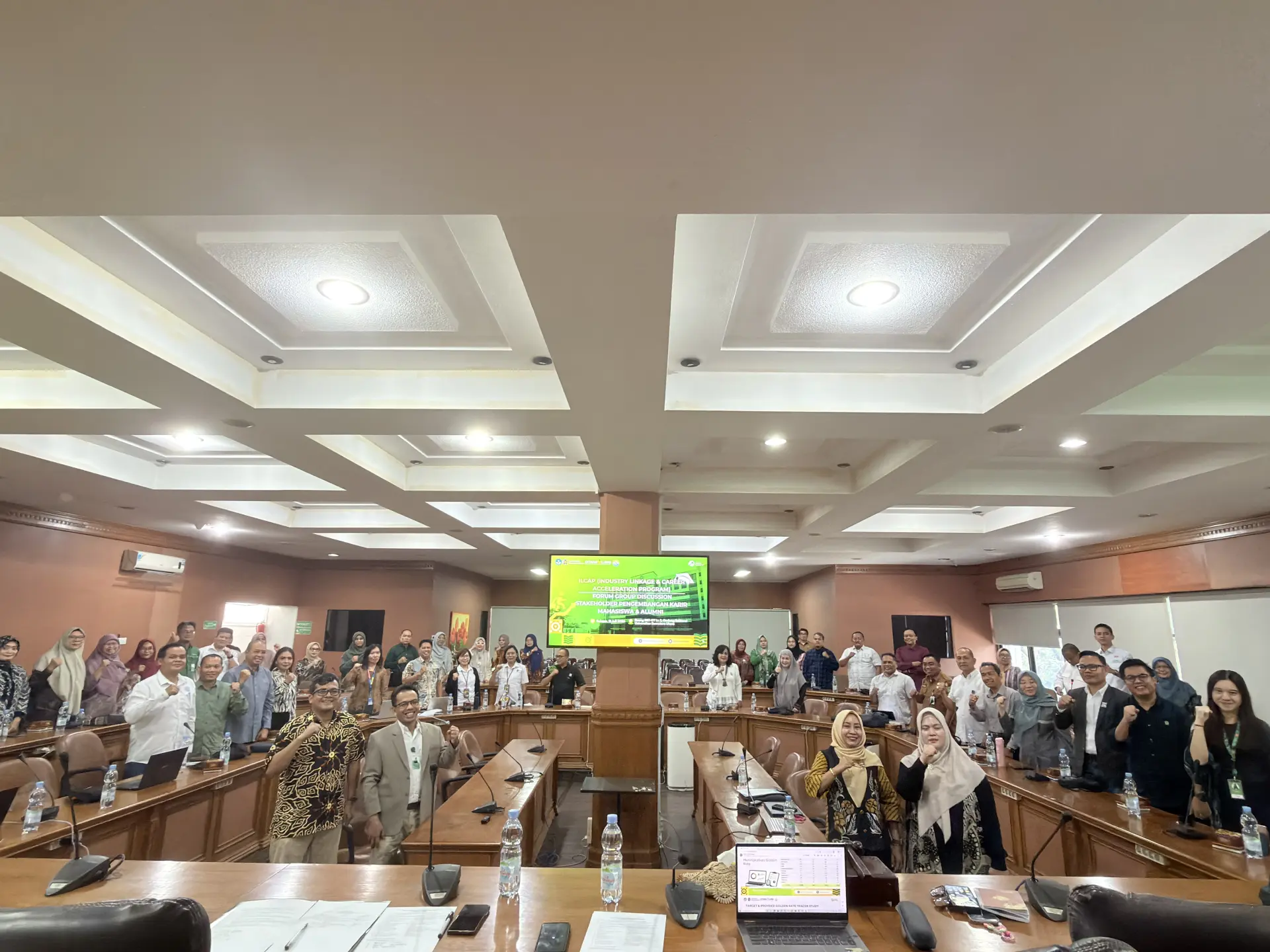
DITMAWALUMNI USU – The Directorate of Student Affairs and Alumni Relations held a Stakeholder Focus Group Discussion (FGD) on Student and Alumni Career Development as part of the Industry Linkage & Career Acceleration Program (ILCAP). The event was held on Tuesday, July 21, 2026, at the IMT-GT Room, 2nd Floor of the USU Rectorate Building.
The FGD brought together various stakeholders involved in the career development of USU students and alumni, including the Universitas Sumatera Utara Alumni Association (IKA USU), Manpower Offices and agencies, businesses and industries, HR communities and associations, as well as Vice Deans I from faculties across USU.
The event began with remarks and directions from Director of the Directorate of Student Affairs and Alumni Relations, Prof. Dr. Ir. Agus Purwoko, S.Hut., M.Si., IPU, followed by an FGD session with the stakeholders.
The FGD aimed to identify gaps between graduate competencies and workforce needs and formulate strategic recommendations for developing the careers and competencies of USU students and alumni. The activity also provided a platform to strengthen collaboration among universities, industry, government, and alumni organizations in creating a career development ecosystem that is more responsive to changing workforce needs.
During the discussion, stakeholders highlighted the importance of strengthening students' soft and hard skills as preparation for entering the workforce. Communication, critical thinking, problem-solving, leadership, adaptability, resilience, and an understanding of workplace culture were identified as key competencies that need to be developed during students' university years.
In addition, technological developments have increased the demand for digital skills, artificial intelligence (AI), data analytics, and the ability to adapt to industrial technologies. Stakeholders also emphasized the importance of foreign language proficiency, particularly English, as well as the growing demand for Mandarin and Japanese language skills in certain fields.
From an educational perspective, stakeholders encouraged USU to continuously adjust and evaluate its curriculum to make it more adaptive to industry needs. Project-based learning, industry-developed training, competency certifications, and tailor-made training were among the recommendations raised during the discussion.
Student internship programs were also a major focus. Stakeholders considered direct work experience essential to helping students gain a better understanding of workplace environments and cultures before completing their studies. Collaboration with businesses and industries is expected to create more opportunities for internships, training programs, career days, career corners, and walk-in interviews for students and alumni.
Strengthening the USU Career Center was another important recommendation from the FGD. The Career Center is expected to function not only as a source of job vacancy information but also as a comprehensive career development center providing training in areas such as CV preparation, professional email writing, LinkedIn optimization, use of job portals, interview preparation, and career projection.
Stakeholders also emphasized the importance of strengthening relationships with alumni. Alumni should not only be positioned as job seekers but also as bridges between the university and industry and as job creators. Strengthening entrepreneurship among students and alumni, as well as fostering a stronger sense of belonging and USU Pride, was identified as part of this effort.
Meanwhile, government involvement through Manpower Offices and training institutions is expected to expand students' and alumni's access to labor market information, industry-based training, and various competency development programs. Collaboration through employment portals and industry-needs-based training programs was also identified as an opportunity for joint development.
The FGD also concluded that the link and match between higher education institutions, industry, government, and alumni is already in place but needs to be strengthened and implemented in a more systematic and sustainable manner. Universities are expected not only to serve as providers of graduates but also to actively produce studies and recommendations that can support industrial development and employment policies.
Based on the discussion, several priorities were identified for follow-up, including strengthening soft skills, aligning curricula with industry needs, improving digital and AI competencies, developing foreign language proficiency, expanding internship programs, strengthening the Career Center, promoting entrepreneurship, and increasing sustained collaboration with industry, government, and alumni.
Through the Stakeholder FGD on Student and Alumni Career Development, USU reaffirmed its commitment to strengthening a career development ecosystem capable of responding to the dynamics of the labor market. The results of the discussion are expected to serve as a foundation for developing programs and policies to strengthen student and alumni competencies, enabling USU graduates to become increasingly adaptive, competent, and competitive at both the national and global levels.